€17.00
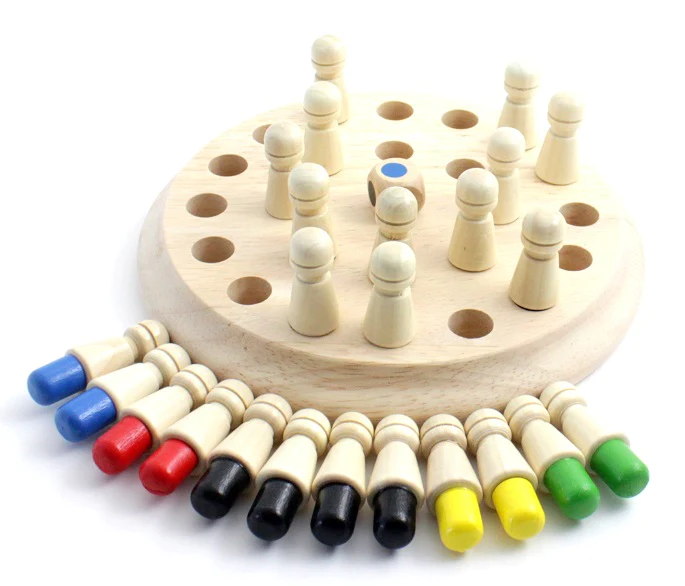
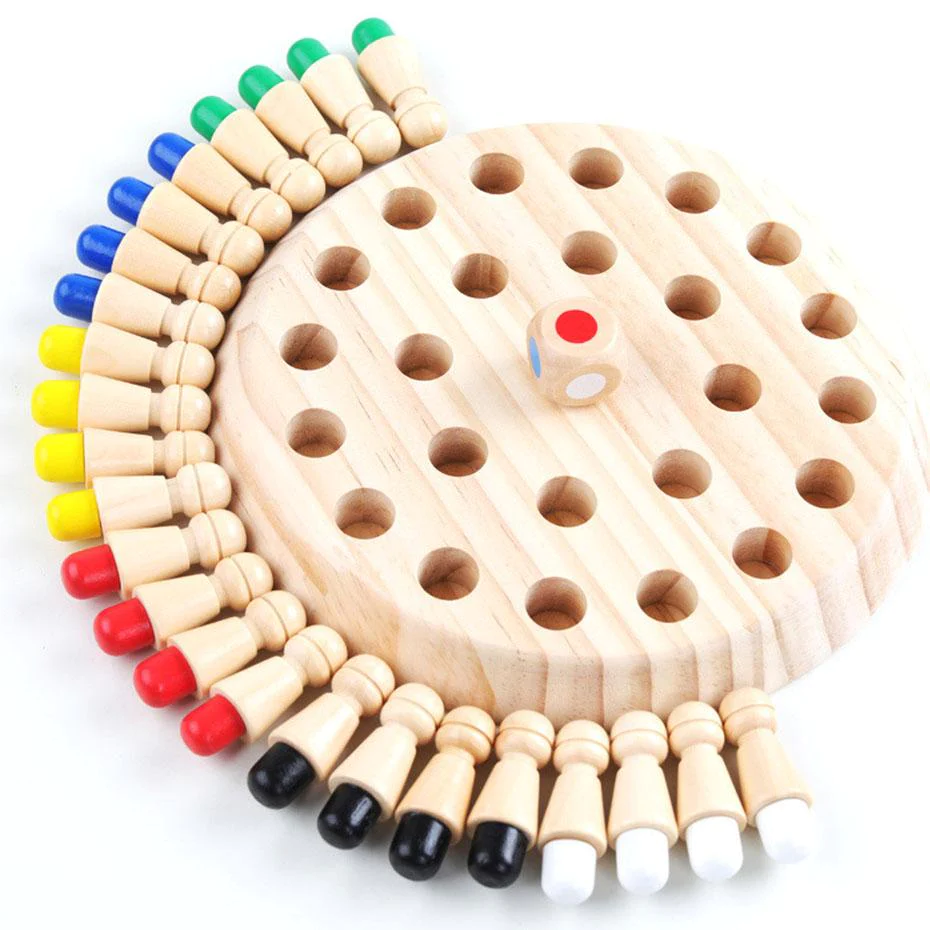
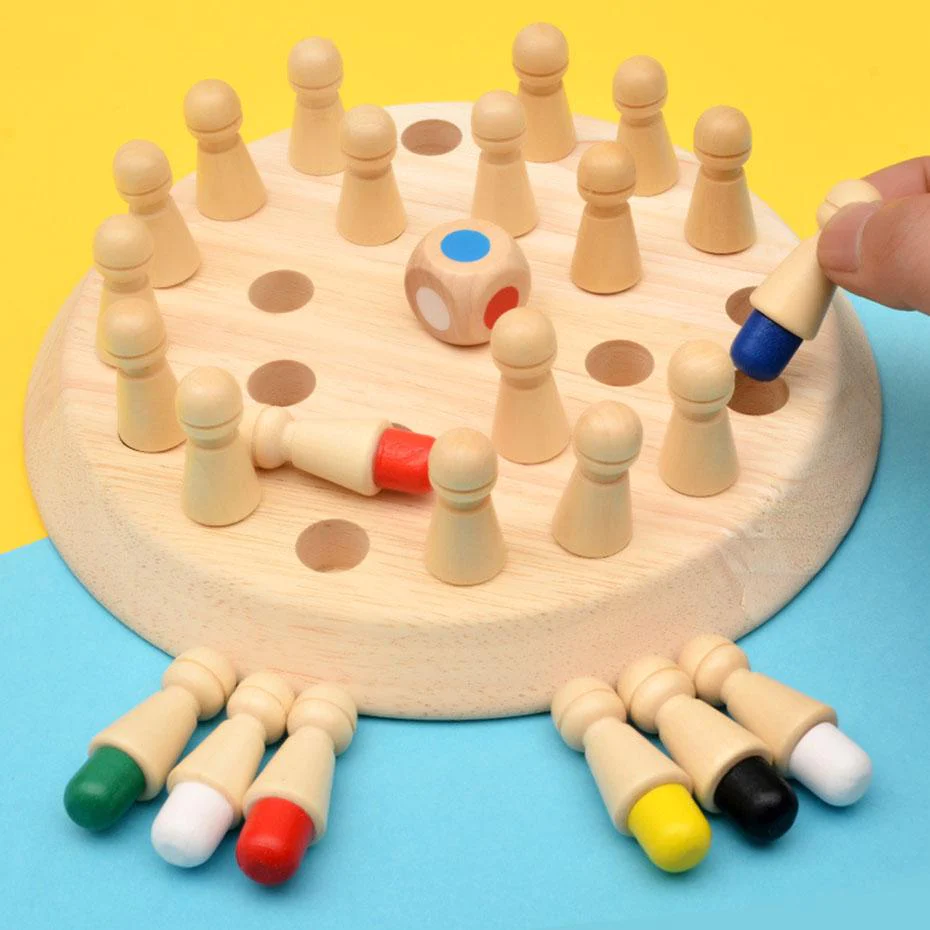
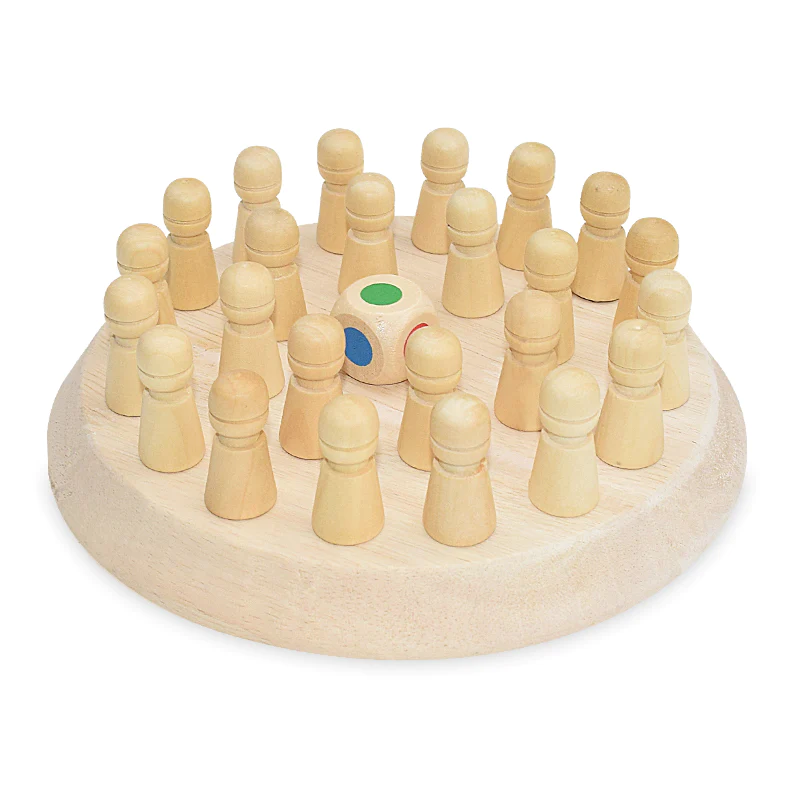
This memory chess game is designed to improve different skills in children.
Playing with this toy can help to improve hand-eye coordination, fine motor skills, concentration.
It can also be beneficial in enhancing memory, exercising observation capability. Since the game should be played with other players, it can be useful for children social abilities.
In stock
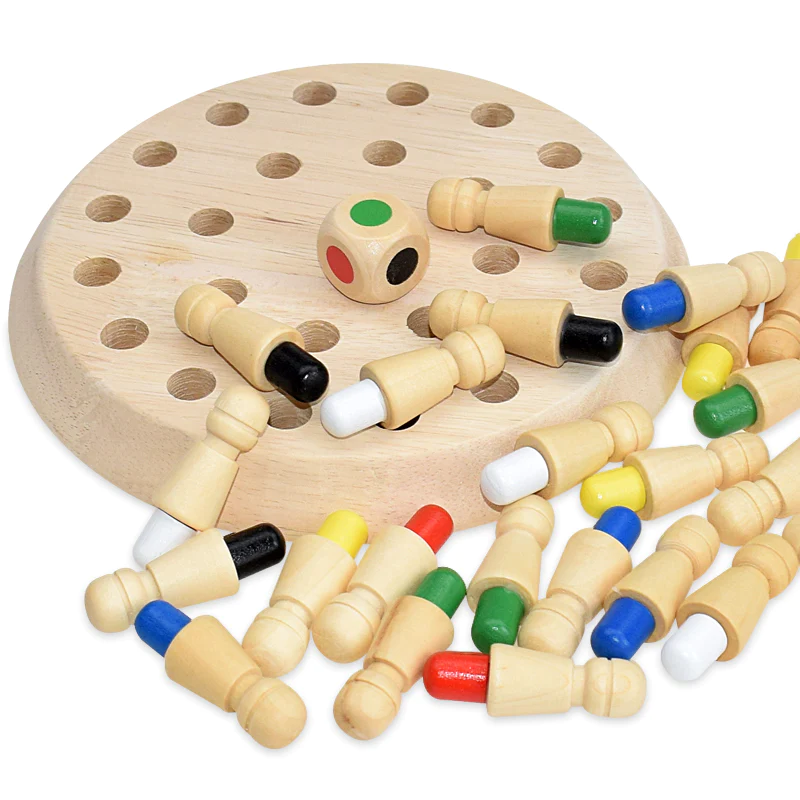
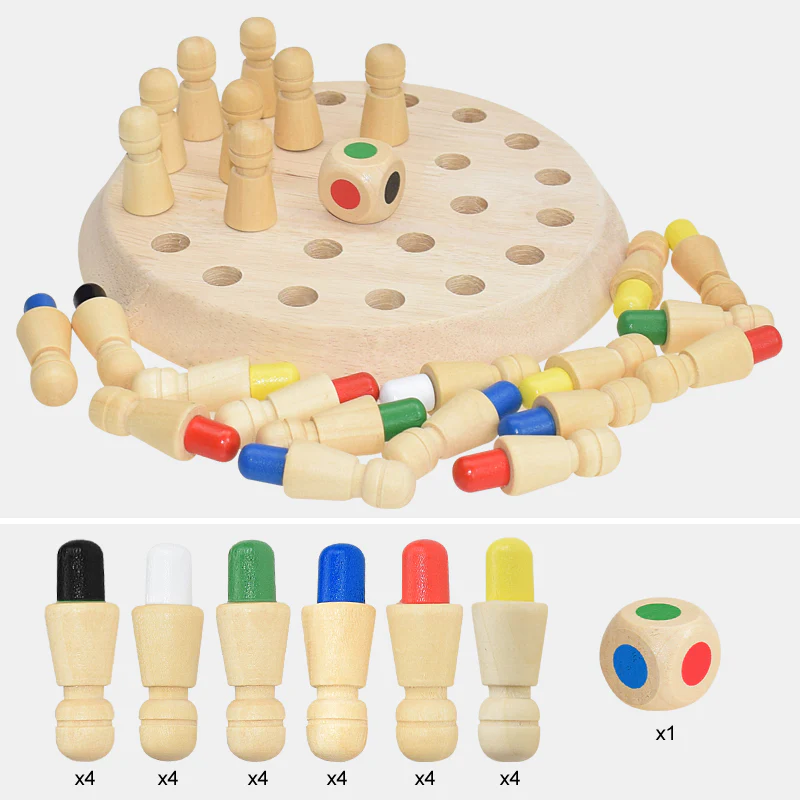
Before starting a game, all chess pieces should be inserted into the wooden board. The color of each chess piece shouldn’t be visible to the players. Once everything is set, the first player should through a dice. A player then has to select one chess piece from the board so that it would match the color on the dice. In the case that color matches, the same player throughs a dice one more time and tries to collect as many chess sticks as possible. If the colors doesn’t match on the chess piece, it should be returned to the board. The next player throughs a dice and continues with a game.
There are three different ways how a winner of this memory game can be determined. It can be all a matter of agreement before each new game. Changing the rules of victory from time to time can make this game less monotonic and fun.
Rule #1: The player who has the largest number of chess pieces after the game is the winner.
Rule #2: The player who collects the same color chess pieces fist is the winner of the game.
Rule #3: The player who collects at least one piece of each color chess first is the winner.
Not recommended for children under 3 years without adult supervision.
| Weight | 0.5 kg |
|---|---|
| Dimensions | 19 × 19 × 6 cm |
| Age | 2+ years old. Age is indicative, use depends on the child's development |
This Montessori wooden toy has cylinders that vary in diameter or height.
Because of this variation, a child will be able to visually differentiate volume, size, height and thickness better. Whenever there is at least one cylinder left without its space on the block, a child must understand the mistake and correct it.
In stock
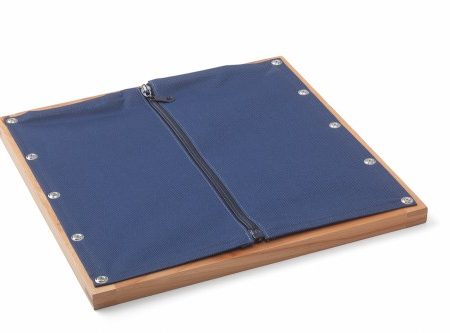
Wooden tray equipped with 6 boxes with holes, which differ in color, the shape of the hole and the type of lock.
Learning objectives: Color discrimination, development of motor skills, recognition of basic geometric shapes, recognition of different types of locks used in everyday life.
In stock
The child inserts the disc into the hole and turns the lid to reveal it.
Object permanence is the understanding that objects continue to exist even when they cannot be felt.
This is a fundamental concept studied in the field of developmental psychology, the subfield of psychology that deals with the development of social and mental abilities of young children.
Not recommended for children under 3 years without adult supervision.
In stock
A wooden box to practice the child in hand-eye coordination and permanence of objects.
In stock
In stock
Become an expert in forests with the puzzles “What fell from the tree”!
Get to know the leaves and fruits of the trees, learn their names.
You can also draw their outlines on a piece of paper and color them.
In stock
Each box has a hole with a well-defined shape, in which only the shape that will be contained in the box itself fits perfectly. The holes are shaped in the basic geometric shapes: in this case it is a hexagon The box is equipped with a green door.
Learning objectives: Color discrimination, development of motor skills, recognition of basic geometric shapes, recognition of different types of locks used in everyday life.
In stock
High quality 3-piece puzzle.
Made with large wooden handles ideal for your child’s hands.
In stock
The set contains two frames with geometric shapes.
A frame with a square, circle, triangle and one with a large circle, a middle circle and a small circle.
Not recommended for children under 3 years without adult supervision.
In stock
High quality 3-piece puzzle.
Made with large wooden handles ideal for your child’s hands.
In stock
Each box has a hole with a well-defined shape, in which only the shape that will be contained in the box itself fits perfectly. The holes are shaped in the basic geometric shapes: in this case it is a rhombus. The box is equipped with a white door.
Learning objectives: Color discrimination, development of motor skills, recognition of basic geometric shapes, recognition of different types of locks used in everyday life.
In stock
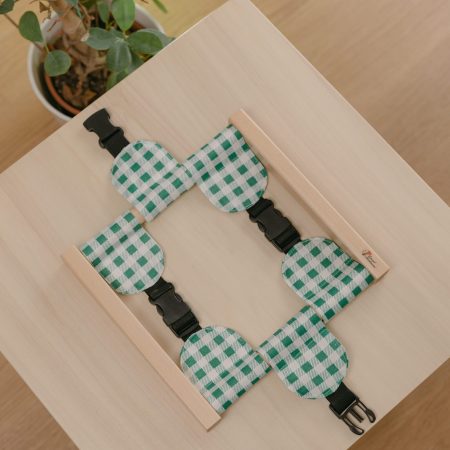
With this material, children learn, in a simple way, to open and close buckles.
In stock